Proper Battery Charging prevent excessive overcharge of the batteries within a battery based power system. Unlike other types of generators, solar panels can be short circuited or open
circuited without causing damage to them. Controllers contain a relay that opens the charging circuit, terminating the charge at a pre-set high voltage and, once a pre-set low voltage is reached, closes the circuit,
allowing charging to continue. Manage your battery life, Get the amp needed using mppt
 Charge
controllers are the gizmo that goes between the solar array and the batteries and are sized to the systems they protect by the short circuit array current and watts matched to the battery voltage. Most common are 12, 24 and 48 volts. Because of cold temperatures and the “edge of
cloud effect”, sporadically increased current levels are not uncommon. For these and other reasons, the size of a controller’s amperage should be increased by a minimum of twenty five percent of the peak solar array
current rounded up. You can also use the manufactures string calculator to correctly size the right charge controller for your battery based system for your zip code.
Charge
controllers are the gizmo that goes between the solar array and the batteries and are sized to the systems they protect by the short circuit array current and watts matched to the battery voltage. Most common are 12, 24 and 48 volts. Because of cold temperatures and the “edge of
cloud effect”, sporadically increased current levels are not uncommon. For these and other reasons, the size of a controller’s amperage should be increased by a minimum of twenty five percent of the peak solar array
current rounded up. You can also use the manufactures string calculator to correctly size the right charge controller for your battery based system for your zip code.
What Size do I Need?
 Take the number of panels x
watts to get the total watts of the solar array. You then divide it by the voltage of your battery bank to get amps, add 25% to allow for cold temperatures and as always, round up.
Example: 2 - 140 watt solar panels in series = 280 watts / 12 VDC battery bank + 25% = 29.18 amps. You would choose a 30 amp, 12 VDC charger in this example. Another example would be
4 - 250 watt solar panels = 1,000 watts / 24V battery bank = 41.7 amps + 25% = 52.09 rounded up = 60 amp controller. Note; Solar charge controllers are rated and sized by the solar panel
array current and system voltage. These examples are simple calculations for small systems. If you have a larger system with muliple strings you are considering, you should look at our
Off-Grid Living page for some preconfigured systems that include the right sized charge controller or consult the charge controllers manufactures string calculator.
Take the number of panels x
watts to get the total watts of the solar array. You then divide it by the voltage of your battery bank to get amps, add 25% to allow for cold temperatures and as always, round up.
Example: 2 - 140 watt solar panels in series = 280 watts / 12 VDC battery bank + 25% = 29.18 amps. You would choose a 30 amp, 12 VDC charger in this example. Another example would be
4 - 250 watt solar panels = 1,000 watts / 24V battery bank = 41.7 amps + 25% = 52.09 rounded up = 60 amp controller. Note; Solar charge controllers are rated and sized by the solar panel
array current and system voltage. These examples are simple calculations for small systems. If you have a larger system with muliple strings you are considering, you should look at our
Off-Grid Living page for some preconfigured systems that include the right sized charge controller or consult the charge controllers manufactures string calculator.
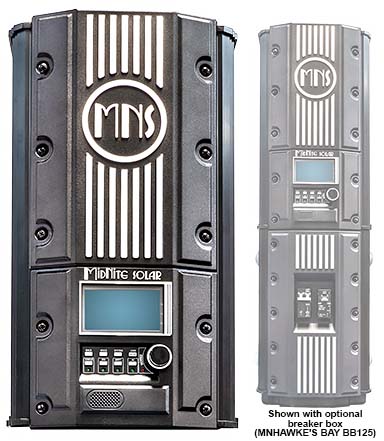
MidNite Solar


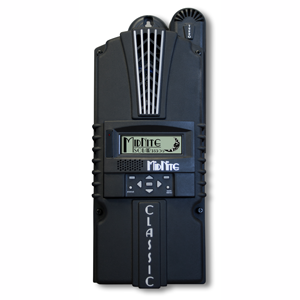
Midnite Solar is an American manufacture that produces a wide range of alternative energy products primarily used in off-grid battery applications. MidNite’s Classic series of Maximum Power
Point Tracking (MPPT) charge controllers are the most powerful, full featured controllers on the market as well as being the only ETL listed controllers designed to
work with Solar, Wind, and Micro Hydro Electric systems.
The typical solar string for battery based systems
is three common 60 cell solar panels in series. Throughout North America, 3 in series is a safe string for MPPT most controllers. The higher voltage Midnite Classic
controllers may accept strings of 4 or even 5, depending on the solar panels and the local climate.
On a cold clear
morning if your solar panel or string of panels Voc exceeds the controller’s limit, the charge controller will protect itself by refusing to turn on. If you grossly exceed the Voc for example by wiring a large
string of panels in series or miss-match your single panel to the controller for instance, you’ll get smoke. Smoke coming our of your charge controller is a bad thing.
 Most MPPT charge controllers work with higher array voltages, which can greatly reduce the required wire size between the array and the charge controller. While more expensive than PWM controllers, MPPT charge controllers can boost system performance by up to 30% making them very cost effective.
*Pulse Width Modulation (PWM) is an effective means to achieve constant voltage battery charging by switching (or pulse) the charge controller’s
power devices. When in PWM regulation, the current from the solar array tapers according to the battery’s condition and recharging needs.
The PWM charge controller constantly checks the state of the battery to determine how fast to send the electrical
pulses, and how long the pulses will be. In a fully charged battery with no load, it may just "tick" every few seconds and send a
short pulse to the battery. In a discharged battery, the pulses would be very long and almost continuous. The charge controller
checks the state of charge on the battery between pulses and adjusts itself each time.
**Maximum Power Point Tracking (MPPT) - A solar panels ideal voltage is that at which it can put out maximum power. Maximum power point, also called peak power voltage abbreviated Vpp
is the maximum energy produced. Maximum power point tracking (MPPT) is a electronic design that charge controller manufactures use to get the maximum possible power from a
solar panel. The cells that make up a solar panel have a complex relationship between solar irradiation, temperature and resistance
that produces a non-linear output efficiency known as the I-V curve. It is the purpose of the MPPT controller to sample the output
of the cells and apply the proper load to obtain maximum power for any given environmental conditions. Essentially, this defines
the current that the inverter should draw from the solar panel in order to get the maximum possible power, as power equals voltage times
current. MPPT controllers are more effective that PWM controllers and save considerable money on larger systems since they provide 16% to 30% more power to the battery.
Charge Controllers, Off-Grid, Deep Cycle Battery Chargers.
Charge controllers are solid-state electronic devices used in nearly every solar and wind energy system that uses batteries. A charge
controller is often times used in off-grid solar systems with 12 volt to 48 volt battery banks to keep the voltage to the batteries within
acceptable limits. A charge controller automatically tapers, stops, or diverts electrical power when systems batteries become fully charged.
Charge controller capacities range from 4 to 80 A and multiple charge controllers can be used in parallel for larger solar battery systems.
Some charge controllers offer additional features, like charge status display,
data logging, automatic battery equalization charging and
generator starting.
The simplest charge controllers cut the power when the battery reaches a set voltage,
and turn it on when a low voltage set point is reached. Pulse width modulated (PWM) charge controllers turn on and off very rapidly, maintaining the batteries at full charge with whatever power is available. Maximum power point tracking (MPPT) charge controllers optimize the voltage of the PV array to maximize total power output then convert that to the correct voltage to charge the battery. This process significantly increases the power from a solar array, particularly in low temperatures when battery voltage is significantly below the PV array voltage. Most MPPT charge controllers work with higher array voltages, enabling the use of larger solar modules, which can be more economical on a cost per watt basis. A higher voltage solar array also minimizes the required AWG wire size between the solar panels and the charge controller. While more expensive than PWM controllers. , The Charge controllers
Blue Pacific Solar sells employ the latest in power electronics to regulate the battery charge by controlling the charging voltage and current from a
solar panel array. Charge controllers regulate the charge of the battery, but also prevent the battery from being over discharged which can damage the
battery bank.
Charge controllers have multiple stages of control it uses to regulate different voltage and current levels. The voltage and current of a battery
varies over the different stages of battery charge. Though the amount can vary, the bulk charge usually is approximately 80%, the absorption charge is 10% with the
float charge representing the balance of the battery charging process. The bulk charging stage of the charge controllers process is the first stage to used to bring the battery depth of discharge (DOD) back to 100%.
The bulk charge stage happens first in in the morning after the batteries DOD has drained down since sunset the previous day. The bulk charging stage
pushes as many amps into the battery bank as possible from the solar panels and gets the voltage up in the process. The effect of a charge controller
is not unlike trying to fill a glass of water from a faucet. You first turn the faucet on full while the glass if filling, then slowly taper off the
pressure until the glass is full. When the battery bank reaches a predetermined level known as the bulk voltage set-point, the charge is then substantially
slowed. Because the bulk voltage set point is determined by the type of battery you are using, many charge controllers have to be pre-set to the type of
battery which will dictate the rate of charge.
The second state of charge a charge controller employs is the absorption stage. After a battery system has been brought up to the bulk voltage set point,
the charge controller slows down the charge rate because the battery bank cannot accept the same rapid charging pace without overheating and damaging the
battery bank. At the absorption stage a battery bank is only about 80% full. The absorption charge is the function level in the process that tops off the
battery bank. During the absorption stage, the charge controller holds the battery volts constant and reduces the amount of current sent into the battery.
When the absorption stage is complete, the battery bank is fully charges.
The final step a charge controller performs is the float charge. Typically a charge controller enters into a float charge state when the other charge
levels of the battery bank has been achieved. When the number of peak sun hours is limited, a solar charge controller may not be able to get the battery
bank back to the float stage before the next cycle begins.